
Kunal Kumar
Co-Founder · Backend & Full-Stack Engineer
· 9 min read
How to Outsource Software Development to India Without Losing a Client (The Agency Owner's Honest Guide)
Every agency owner has had the same conversation with themselves at least once. A good project comes in — the budget is solid, the client is reasonable — but your team is already at capacity. You either turn it down,…
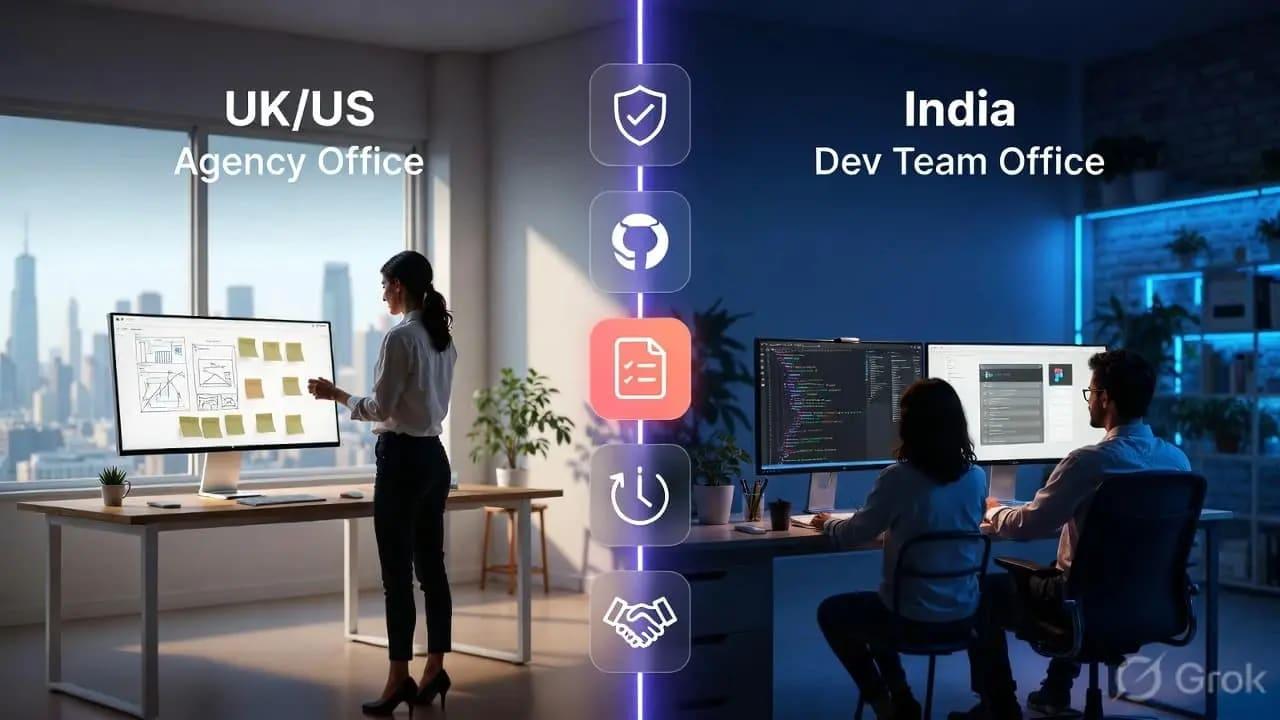
Every agency owner has had the same conversation with themselves at least once. A good project comes in — the budget is solid, the client is reasonable — but your team is already at capacity. You either turn it down, overstretch your people, or find someone external to bring in. That last option — outsourcing — sounds straightforward. It rarely is. The first time most agency owners outsource development to India, something goes wrong. A deadline slips. The code is a mess. The communication falls apart at a critical moment. They swear they'll never do it again. Then capacity hits again, and they're back to square one. The problem was never outsourcing. The problem was doing it without a framework. This guide fixes that. If you're a UK or US agency owner considering outsourcing software development to India — for the first time or after a bad experience — this is the honest, tactical playbook you actually need.
Why Smart Agency Owners Outsource Development — And Why Some Get Burned
Let's be honest about the motivation first. Outsourcing to India isn't just about cost — though the cost difference is significant. A senior full-stack developer in the UK costs £65,000–£85,000 per year. The equivalent skill level in India costs £18,000–£30,000 per year. For a project-based engagement, UK freelancers charge £400–£700/day. Indian development companies charge £150–£280/day for the same output quality — when you pick correctly.
But cost is only part of the picture. The deeper reasons agencies outsource are:
Capacity without hiring risk Hiring a full-time developer is a 6–12 month commitment minimum. Outsourcing lets you scale up for a project and scale back down without redundancy costs, notice periods, or employment law headaches.
Access to a full team, not just one person A good Indian development partner gives you a developer, a designer, a QA tester, and a project manager — for less than the cost of one full-time UK mid-level developer.
Speed to delivery With a dedicated external team, you're not competing for internal bandwidth. The project gets focused attention from day one.
Where agencies get burned: they treat outsourcing like placing an order online. They send a brief, expect delivery, and skip the process. Without the right framework, any development engagement — local or overseas — goes sideways.
Before You Outsource Anything: 4 Things to Get Right First
The work you do before a development partner writes a single line of code determines 80% of your outcome. Most agencies skip this entirely.
1. Document the requirement properly Vague briefs produce vague software. Before approaching any development partner, you need at minimum: a feature list broken down by user role, a clear definition of what 'done' looks like for each feature, and wireframes or a reference product if possible. You don't need a 40-page technical specification — but you do need more than a paragraph and a verbal conversation.
2. Separate 'what' from 'how' Your job as the agency is to define what the product needs to do. The development partner's job is to decide how to build it technically. When agencies over-specify the technical approach without the expertise to back it up, they create confusion and conflict mid-project. Trust the technical partner to make architecture decisions — hold them accountable to the functional outcome.
3. Agree on success criteria before work starts What does a successful delivery look like? Define it in writing before the engagement begins. Page load time targets. Browser compatibility. Test coverage expectations. Deployment environment. Handover documentation requirements. If these aren't defined upfront, every disagreement at the end becomes a grey area.
4. Decide on your communication cadence How often do you need updates? Weekly sprint reports? Daily Slack messages? A live call every two weeks? Lock this in at the start. A development partner who doesn't hear from you for three weeks will fill that space with assumptions — and assumptions in software development are expensive.
How to Evaluate an Indian Development Company (Without Getting Fooled by a Good Portfolio)
Any development company can show you a beautiful portfolio. What you're actually evaluating is their process, their communication style, and what happens when things don't go to plan.
Ask these questions on the first call:
- Walk me through how you handled a project that went off-track. What happened and how did you resolve it?
- How do you manage scope changes mid-project?
- Can I speak to a previous agency client as a reference?
- What does your code handover process look like?
- How do you handle bugs found after project delivery?
The answers reveal far more than a portfolio walkthrough ever will. You're looking for: transparency about problems, a structured process for handling change, and evidence of accountability.
Technical due diligence checklist:
✅ Ask to see a sample of their actual code from a previous project — even a sanitised snippet ✅ Check their GitHub organisation or profile for activity and code quality ✅ Ask what their testing process looks like — unit tests, UAT, QA sign-off ✅ Ask which project management tool they use and whether you'll have access ✅ Confirm their deployment and hosting process — do they use CI/CD pipelines?
Red flags to walk away from:
🚩 They quote a price within 10 minutes of hearing your brief — no serious partner can estimate without understanding scope 🚩 One person is the developer, project manager, designer, and QA 🚩 They can't give you a reference from a previous agency client 🚩 Their portfolio shows beautiful designs but they can't explain the technical architecture 🚩 They avoid putting delivery timelines in writing
The Legal Framework Every Agency Must Have in Place Before Starting
This is the section most agency owners skip. Don't.
Non-Disclosure Agreement (NDA) Sign this before you share any brief, client name, design asset, or technical requirement. A professional development company will have a standard NDA ready — you shouldn't need to ask. If they resist or delay, that tells you everything.
IP Assignment Clause The NDA protects confidentiality. The IP assignment clause ensures that everything built — code, designs, database schemas, documentation — legally belongs to you (or your client) upon payment. Without this clause explicitly in your contract, IP ownership is ambiguous in most jurisdictions.
Scope of Work Document (SOW) This is your project bible. It should include: full feature list, acceptance criteria, delivery milestones, payment schedule tied to milestones, and the process for handling scope changes. Anything not in the SOW is out of scope — and should be quoted separately.
Payment Structure Never pay 100% upfront. A professional structure: 30% on project kick-off, 40% at mid-point milestone (working demo), 30% on final delivery and sign-off. This structure protects both parties and maintains healthy accountability throughout.
Warranty Period Any professional development company should offer a post-launch warranty — typically 30–60 days — covering bug fixes for issues that arise from their code. Get this in writing before you sign.
How to Manage a Remote Development Team Like a Pro (Even If You're Not Technical)
Once the contract is signed, your job shifts from evaluator to project sponsor. You don't need to be technical to manage a development engagement well — you need to be structured and consistent.
Set up communication infrastructure on Day 1 A shared Slack channel or WhatsApp group. A shared project board (Jira, Notion, or Trello). A recurring weekly call with a standing agenda. Set these up before a single line of code is written.
Review sprint demos — not just sprint reports Anyone can write a status update that sounds like progress. Ask to see a live or recorded demo at the end of every sprint. Working software is the only honest measure of progress in development.
Protect your client relationship proactively If a sprint is running behind or a feature needs rework — tell your client before they ask. Never let a delay reach your client without warning from you first. Your development partner's problem becomes your credibility problem the moment your client finds out from someone other than you.
Keep a decision log Every significant decision made during the project — a feature change, a technology choice, a timeline adjustment — should be documented in writing, even if it's just a quick message in Slack followed by 'confirmed'. This protects you if there's a dispute at handover.
Don't disappear The single biggest cause of failed outsourcing engagements is an agency owner who gets busy, disengages from the project for two weeks, and comes back expecting everything to be on track. Remote teams need regular input and feedback. The more responsive you are, the faster and better the output.
Project Handover and Building a Long-Term Partnership
The handover is where most outsourcing relationships either solidify or collapse. Do this right and you'll have a reliable development partner for years. Do it poorly and you'll inherit a codebase only the original developer understands.
What a proper handover includes:
- Full GitHub repository access under your organisation account
- README documentation covering: project architecture, local setup instructions, environment variables, deployment process
- Inline code comments on all non-obvious logic
- Database schema documentation
- List of all third-party services, API keys, and credentials (stored securely)
- A recorded walkthrough video of the codebase — 20–30 minutes, narrated by the lead developer
The long-term partnership model The best agency-developer relationships don't end at project delivery. They evolve into retainer arrangements — a fixed number of hours per month for ongoing features, bug fixes, and technical support. This model works well for both sides: you get guaranteed capacity without the commitment of employment; they get predictable revenue and a client they already know.
Start with a project. If the process was smooth, the code was clean, and the communication was reliable — move to a retainer. That's how you stop scrambling for a development partner every time a new project lands.
Why Agency Owners Choose Kunamix as Their Development Partner
Kunamix is a full-stack software development company based in India, built from the ground up to serve as a reliable, invisible development partner for agencies in the UK, US, Canada, and UAE.
Here's what makes us different from the hundred other companies you'll find on a Google search:
We built our process around agency needs specifically We understand that your reputation is on the line with every project. Our entire workflow — from NDA to handover — is designed to protect your client relationship and your brand.
We are a team, not a freelancer Five people: full-stack developers, a UI/UX designer, and a project lead. One person being unavailable doesn't stall your project.
Our tech stack is modern and maintainable React, Next.js, Node.js, PostgreSQL, MongoDB, React Native, Flutter, AWS. We don't use outdated frameworks that create long-term maintenance problems. Every codebase we deliver is clean, documented, and handover-ready.
We communicate in your timezone Overlap hours with UK (9am–2pm GMT) and US East Coast (10am–3pm EST). Daily async updates. Weekly live calls. You are never chasing us.
We're transparent about what we can and can't do If a project is outside our expertise, we say so upfront. We don't take projects to figure them out on your budget and timeline.
Final thoughts
Outsourcing software development to India works — when you treat it like a professional engagement, not a transaction. The agencies that get burned are the ones who skip the process: no proper brief, no legal framework, no communication cadence, no handover standards. The agencies that thrive are the ones who build a real partnership with a development team they can trust — and then scale that relationship over time. If you're ready to do it right, Kunamix is built exactly for this.
Ready to Find a Development Partner Your Agency Can Actually Rely On?
Book a free 30-minute discovery call with Kunamix. We'll walk you through our process, answer your due diligence questions honestly, and tell you upfront whether we're the right fit for your project.